Showing posts with label art. Show all posts

Tuesday, May 10, 2011

Migration Period Art


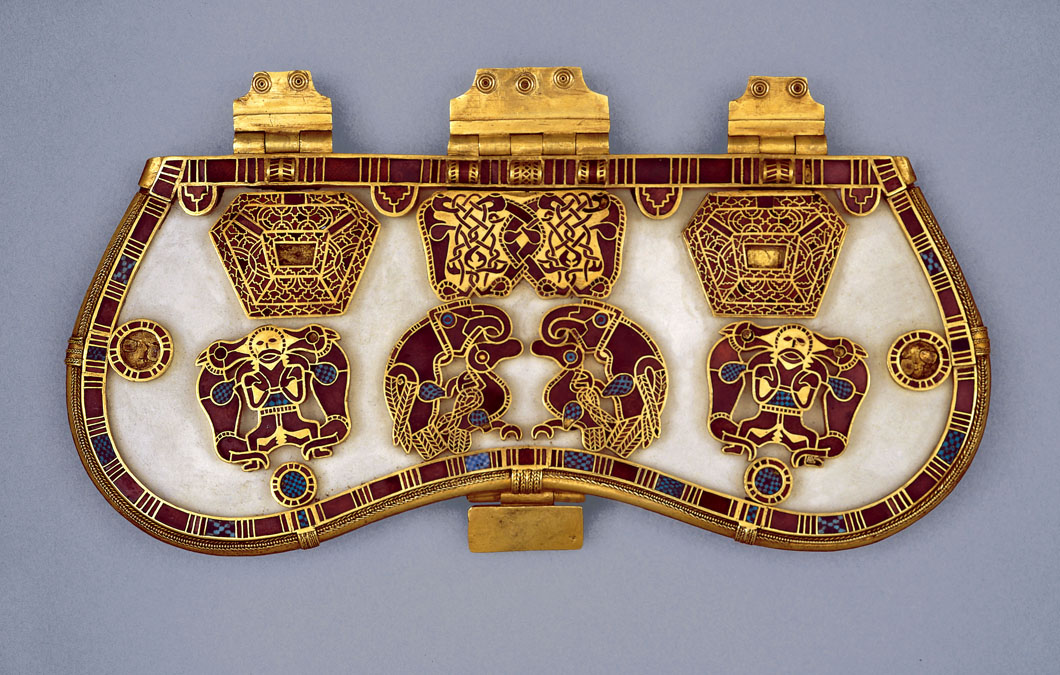
By the end of the 6th century, the Western Roman Empire had been almost entirely replaced with small Germanic kingdoms of people, including the Visigoths, Angles, Saxons and the Huns that had migrated from Scandinavia and other points in Eastern Europe. These Kingdoms shared common traditional features but due to the nomadic nature of these people historically, they encountered many different cultures and ideas which presented itself in their artworks. An example of this is the purse cover found at Sutton Hoo. Constructed in gold and enamel using the animal style, the purse cover features a standing man between two facing animals. This figure first shows up in Mesopotamian art about 3,200 years earlier. Other facets of the ornamentation include interwoven patterns containing parts of fighting animals and interlacing bands of decoration. Migration Period art was mobile art with a utilitarian function, such as weapons, tools and jewelry to fit in with a nomadic existence. The art of the Germanic peoples is almost entirely personal adornment, portable, and taken to the grave where it would act as an offering to dead spirits for protection of the living as exemplified by archeological finds such as the ship burial at Sutton Hoo. No monumental architecture or sculpture of permanence has been found to contradict this finding. Furthermore, the objects found at Sutton Hoo are important because they demonstrate the exchange of designs and techniques through contact with different cultures encountered. These objects have relation to the art of the Germanic people, Scandinavian roots and make reference to Christianity. Some scholars have speculated about the crosses on the Sutton Hoo Clasps and silver bowls with crosses on them also indicate an awareness of the new religion. The portability, assimilated styles and durability of materials used in the art of the migration period clearly indicate its creators were migratory people.

Monday, April 25, 2011

For the Art History Nerd in You

This is Awesome! See if you can Identify all of the paintings by name and artist!


Tuesday, February 23, 2010

Leonardo DaVinci; Writings from his undated manuscripts

Leo DaVinci was brilliant. Perhaps most famous for the "Mona Lisa" which hangs in the Lourve in Paris and the fresco entitled "The Last Supper" C.1495-1498 that is painted over the door in the Santa Maria delle Grazie in Milan, he was a painter, sculptor, engineer, musician, architect, and always a scientist. Leonardo was born in 1452 in the town of Vinci in the Tuscan region of Italy. He was taken from his mother at the age of 5 and was also left handed. He wrote backwards probably because he was left handed. He trained under Verrocchio as an apprentice painter in his Florence workshop. He was constantly curious of the hman body and frame and even observed and participated in Autopsies which were outlawed by the Catholic Church at the time. DaVinci created many great works throughout his life and travels. He was truly and literally a "Renaissance Man." Probably a little less know were some of his sketch journals and writings. Amongst his sketches of the human body and figure, were studies of flowing water, rocks, war machines and UFOs. Thanks to patrons like Bill Gates who recently paid $35 Million USD for one of Leonardo's notebooks, we, the general public are able to see some of these on display.


Self Portrait (1512)
Leonardo wrote about many different topics, truly a "Renaissance Man". Paragone was a common subject in High Renaissance Scholarship. The following writings are from some of his undated manuscripts containing sketches of studies of the human form, the way water relates to rock as it falls over the edges of it, architectural drawings along with musings on how he saw the world around him.

WRITING FROM AN UNDATED MANUSCRIPT

He Who Depreciates Painting Loves Neither Philosophy nor Nature

If you despise painting, which is the sole imitator of all visible works of nature, you will certainly be dispising a subtle invention of all forms -- Sea and land, plants and animals, grasses and flowers-- which are enveloped in shade and light. Truly painting is a science, the true-born child of nature. For painting is born of nature; to be more correct we should call it the grandchild of nature, since all visible things were brought forth by nature and these, her children, have given birth to painting. Therefore we may justly speak of it as the grandchild of nature and as related to God.

Of the Sculptor and Painter

The sculptor's art requires more physical exertion than the painter's. That is to say, his work is mechanical and entails less mental effort. Compared with painting, there is little scientific research; for the sculptor's work consists only of taking off from the same material, while the painter is always putting on a variety of materials. The sculptor gives all his attention to the lines that circumscribe the material which he is carving and the painter studies these same lines, but he has besides to study the shade and light, the color and the foreshortening. With respect to these the sculptor is helped throughout by nature, which supplies the shade and light and the perspective. While the painter has to acquire these by dint of his ingenuity and has himself to play the part of nature, the sculptor always finds them ready made.

~Leonardo Da Vinci (1452- 1519)